The story behind the melancholic Borghese St John, one of Caravaggio’s last works
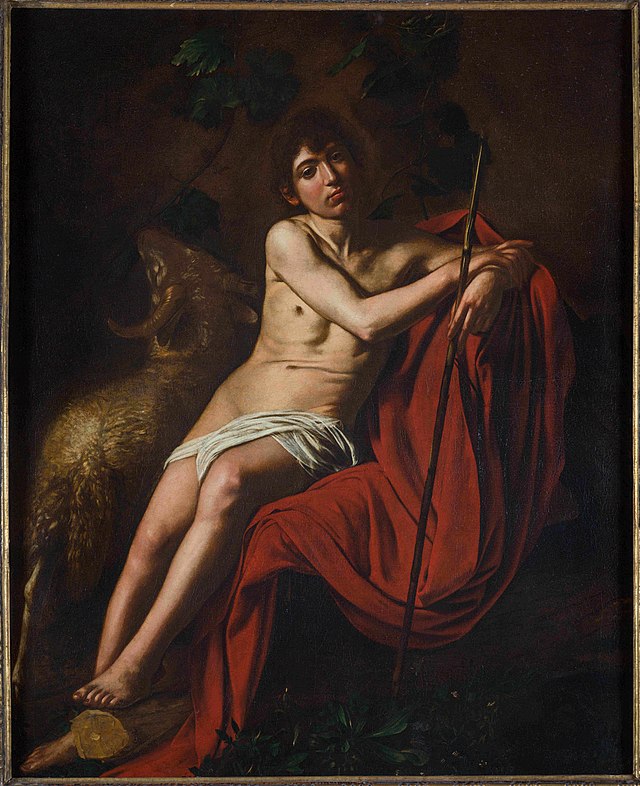
Within the lavish confines of Rome’s Villa Borghese is a room, the Sala del Sileno, devoted to Caravaggio. No other room in Italy or indeed the world has as many works by Caravaggio within its walls. Six of his paintings are hung there, two of them among the most famous by his hand: the self-portraits Sick Bacchus (1593/94) and David with the Head of Goliath (1609/10). Facing these on the wall opposite is St John the Baptist, painted in 1609/10 and possessed of a still, enchanting power. It is the last known work on John that Caravaggio painted, and one of the final works of the artist’s life. Of the three paintings that Caravaggio took with him on his fateful journey to Porto Ercole, one was the Borghese St John.
It is a painting closely linked to the confusing and still obscure events surrounding the artist’s death in July 1610. It was painted during Caravaggio’s fraught spell in Sicily in 1609, where the artist had fled after escaping imprisonment in Malta by the military Order of St John. He had been locked up for a violent assault on Giovanni Rodomonte Roero, a count and fellow (albeit far more distinguished) member of the Order. In Sicily, both Roero and the Order were on Caravaggio’s trail. His St John, a drowsy image of calm, was thus born at a time of intense stress and anxiety. One or the other of his assailants would eventually catch up with him in Naples in a brutal attack outside the Osteria del Cerriglio that left Caravaggio “almost unrecognisable.”
Seven works by Caravaggio featuring John the Baptist survive (others, like the Toledo St John, are disputed). The largest, in the oratory of St John’s co-cathedral in Valletta, is the best known, showing John being executed by his captors; two, now in London and Madrid, depict Salome with John’s decapitated head; the remaining four, the Borghese St John included, show the Baptist in the wilderness.
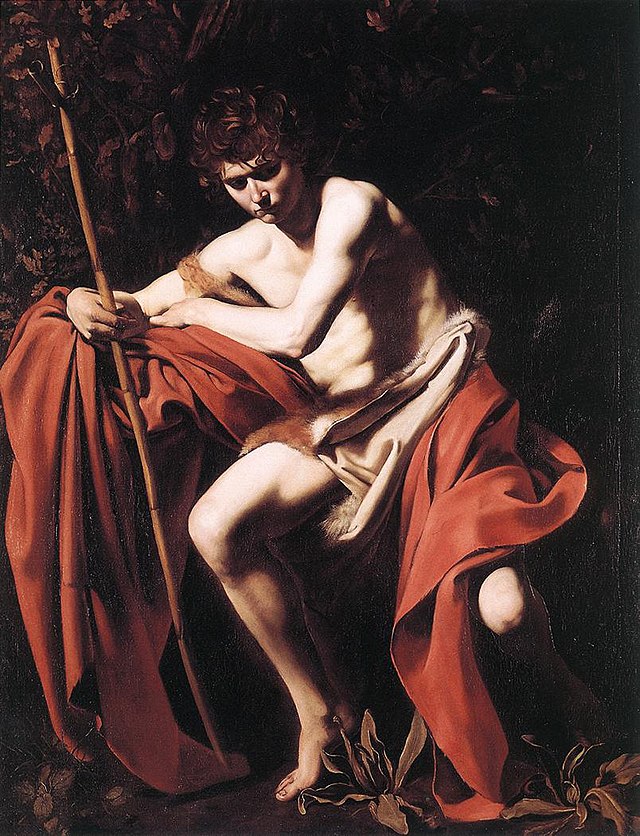
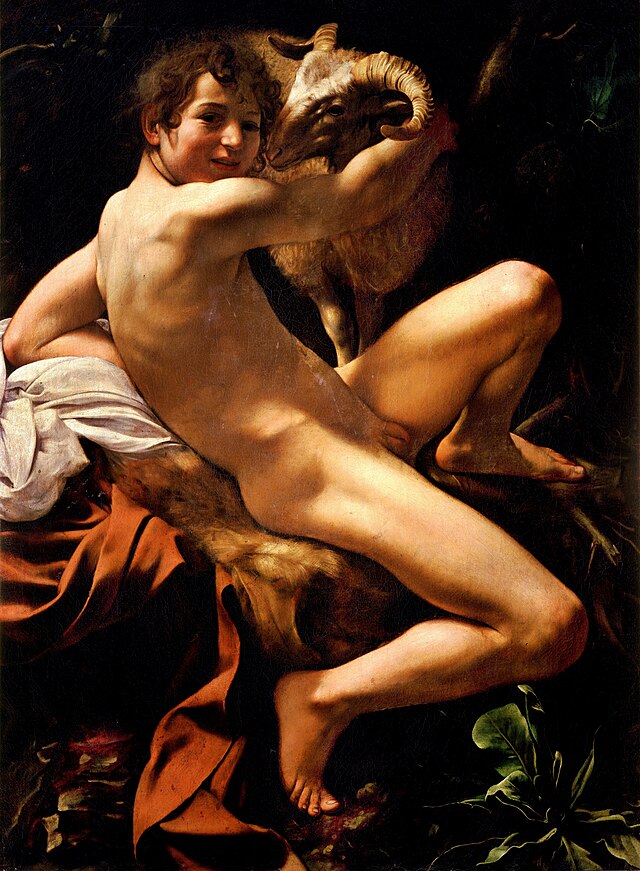
“I am the voice of one crying in the wilderness” – John the Baptist, forerunner of Christ who, fulfilling Old Testament prophesies, prepares the path for the Son of God. Artists’ portrayal of John took as their guide the Gospels’ account of his life and appearance. In the Book of Mark, John is described as baptising in the wilderness, “clothed with camel’s hair, and with a girdle of a skin about his loins.” In the Borghese St John Caravaggio forgoes the camel pelt, but includes other signifiers of the Baptist: the staff, the loincloth, the blood-red drapery, and the lamb of God – here, as in the Capitoline John (above) rendered as a ram, probably a translation of the Biblical Greek arnion which serves for both lamb and ram.
John is a tragic, lonely figure – a mystic, a preacher of repentance who will, like Christ, be condemned to death unjustly. Knowledge of his upcoming death is written on the face of the Borghese John, and it is hard not to read in his mournful expression a reflection of Caravaggio’s own isolation, which was spiritual as well as physical. In Sicily, an early biographer relates Caravaggio being encouraged to repent of his venial sins. “Mine are all mortal” was Caravaggio’s reply. No doubt on his mind was his killing of Ranuccio Tomassoni, a thug with friends in high places, back in Rome in 1606. He had been on the run ever since. Caravaggio, like John the Baptist, is condemned, and knows it. Unlike John, Caravaggio does not believe he will be redeemed after death.
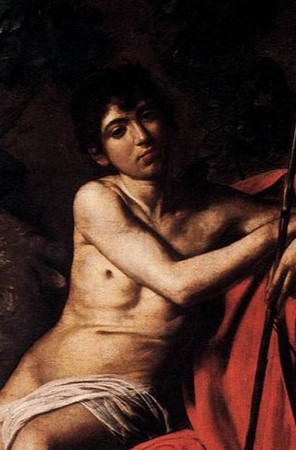
In the Borghese St John, the Baptist dominates the picture plane, cast in the familiar light and shade of Caravaggio’s high-pitch chiaroscuro. The background is a bare wall save for vines and the shadow they cast. The Baptist is seated, facing and indeed staring out at us, his body twisted, the legs feminine and fleshy. His left foot rests on a log, his right on the ground, both blackened in true Caravaggean style. In his left hand he languidly supports his staff, which tilts gently, while his right rests upon his left forearm. He is nude save for a dirty white loincloth, which has slipped from his waist and only just protects his modesty. He has a very slight belly, none of the taut muscular energy of Caravaggio’s earlier Johns. This John is all sensuality. Behind him, a ram nibbles on a vine, with its backside, like Caravaggio’s horse in the Cerasi chapel, directed at the viewer.
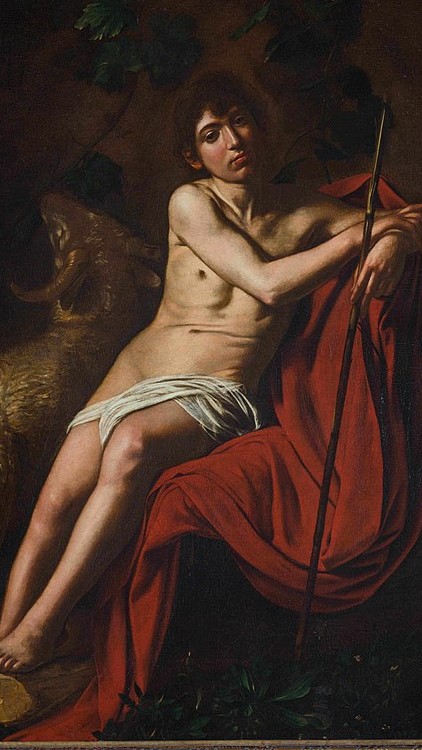
John is achingly young. There is not a hair on his torso and his cheeks are youthfully rosy. The painting is sleepy, even nonchalant (the ram can’t even be bothered to face us) save for something in John’s face. There is something in his expression, a blend of boredom, melancholy and self-awareness. Caravaggio biographer Peter Robb describes John’s face as “the beak nosed, full lipped, black eyed face of Magna Graecia.” This is a lad from Southern Italy, probably Sicily. Indeed, we have a good idea who might have served as the model. The priest Francesco Sussino, in his Lives of the Messinese Painters, writes of Caravaggio hanging around some young Sicilian schoolboys and of being suspected of being sexually attracted to them. It is likely that the model for the Borghese St John is one of these Sicilian schoolboys.
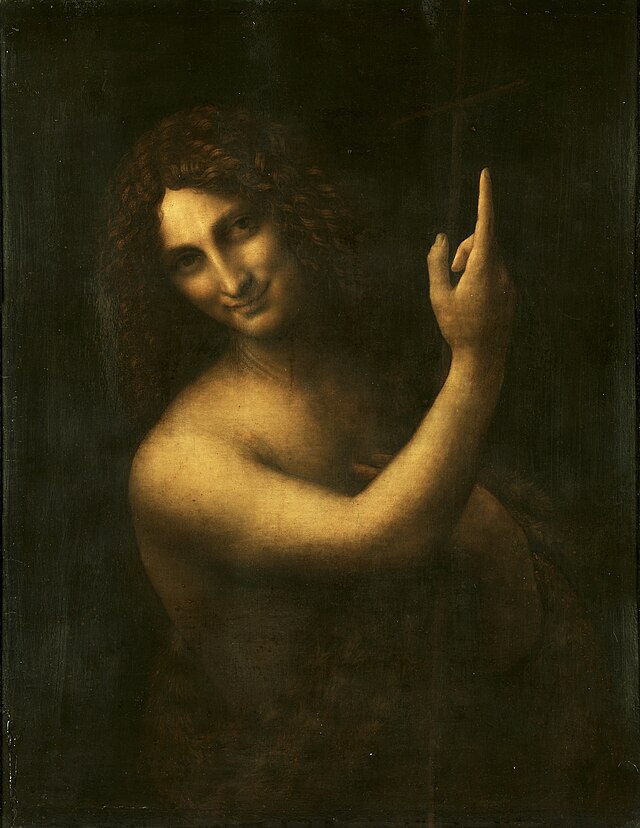
The rather louche John depicted here is dripping in sensuality, and indeed it was not uncommon for artists to imbue St John the Baptist with sexual overtones. Already we have the Capitoline St John of Caravaggio’s, the playful prepubescent nude with a cheeky smile. Leonardo’s St John (1513/16) also has the eponymous figure fix the viewer with a suggestive stare and a beguiling curl of the lips. Caravaggio’s homoerotic Borghese John should therefore be considered part of a tradition of depicting John the Baptist as an alluring, attractive young man.
It is typically considered folly to try and discern the artist’s life in the work, but it is worth doing so in the case of the Borghese St John. Caravaggio’s life when he painted it was a mess. That is hardly unusual – his whole life was wracked by turmoil. But many have been tempted to read in it and other late works of Caravaggio’s evidence of his awareness that, like John, his fate is sealed. Peter Robb rubbishes this idea, seeing instead in his late oeuvre strong signs of a revived vivaciousness. Regardless, one can only try not to read Caravaggio’s late works in the retrospective knowledge of what was to happen to him. Yet it is not cod psychology to see in the manner that Caravaggio has set his Borghese John a comment on the artist’s state of mind.
READ: Caravaggio, Santa Maria del Popolo
Caravaggio, at the time of the Borghese St John, was in a bind. To free himself from it, he needed to return to Rome. It was his home, the place where he had slogged it out to become a famous artist. To achieve this, Caravaggio needed a papal pardon for the murder of Tomassoni, which had led to the bando capitale and all his subsequent wanderings in Naples, Malta and Sicily. Receive this pardon, and not only would the Roman death sentence hanging over his head evaporate, his chaotic life on-the-run from the Order, from Roero and from Tomassoni’s relatives would be extinguished, none of whom would be able to touch Caravaggio were he given papal protection. The person who could grant it was Cardinal Scipione Borghese, papal nephew and, usefully, a voracious art collector.
It is unclear whether the pardon was ever obtained. A Roman newspaper published shortly after Caravaggio’s death advises that it had been granted, but a contemporary biographer records that it was being negotiated on Caravaggio’s behalf by Cardinal Gonzaga via Cardinal Borghese. The price Borghese would exact would be Caravaggio’s unsold paintings, including the Borghese St John. Word duly came through that a pardon was in the offing. In early July 1610, Caravaggio sailed northwards from Naples on a felucca bound for Porto Ercole.
He must have been in a state of nervous excitement: the pardon, for which he had so long yearned, was within reach. We know what happened next only from a letter from Deodato Gentile, Bishop of Caserta and papal nuncio in Naples, to Cardinal Borghese. Gentile explains that Caravaggio had disembarked at Pola, near Rome, a week after departure, where he had been arrested. Why is unclear, but we know that there was an “uproar.” The felucca then continued its journey to Porto Ercole with Caravaggio’s paintings, including the St John, in its hold. Caravaggio had then paid for his freedom and, seeking to recover his paintings, set out for Porto Ercole on foot, where he died from exhaustion.
Not everything about this account makes sense, not least that Porto Ercole is miles from Pola, and that it would have been foolish to travel there on foot, especially in the July sun. Robb has posited that Caravaggio never even made it to Porto Ercole, that the story of him expiring on a beach from fever is a red herring intended to conceal the fact that he had been lured to Pola by the Order of St John and murdered there before he could reach the protection of Borghese. Andrew Graham Dixon, another Caravaggio scribe, believes Caravaggio to have rode from Pola to Porto Ercole on horseback, and that the story of him going on foot was intended to perpetuate the idea, put about by Caravaggio’s enemies, that he was crazy. In any case, we do not know for certain where or how Caravaggio died, or where he is buried. The truth is likely to remain elusive.
What of the St John? It and the two other paintings of Caravaggio’s on board the felucca go not to Rome and Cardinal Borghese but to Naples and Costanza Colonna, in whose palace Caravaggio had stayed during his second spell in the city. A sordid grasping follows: a representative of the Order of St John demands ownership of the three works on the feeble basis that, Caravaggio being a member of the Order and having died intestate, the works belonged them. Nonsense, of course: Caravaggio had been publicly expelled from the Order. That the Order, which had imprisoned him, ceremonially stripped him of membership and later sought his capture, was now desperately trying to get its hands on his paintings represents a small, posthumous victory for Caravaggio.
In August 1610, the St John was finally sent to Cardinal Borghese, in whose villa it has remained. Go and see it.
 Jake Plenderleith