British Jews shouldn’t have to fear for their safety
My next post was supposed to be on Amedeo Modigliani and his older brother, Giuseppe. I knew a little about Amedeo and his work, but I’d never heard of Giuseppe Modigliani until reading John Foot’s Blood and Power, a history of Italian fascism. Giuseppe was a lawyer and a politician, and an indomitable anti-fascist who left Italy for exile in 1926. During the Fascist’s ascendency, he had been the victim of antisemitic violence, threats and intimidation (he came from a family of Livornesi Jews) which included attacks on his person and property. Nevertheless, with characteristic dignity, he remained unbowed and stuck to his beliefs. In 1944, Giuseppe returned to his country of birth and resumed his role in politics.
As I read about this brave and intelligent man, I set aside some time to study more closely the life and work of Amedeo. I thought it was curious and compelling that two brothers had exerted an influence on their time in the contrasting spheres of politics and art. Theirs had been full, productive lives which I thought were worth writing about.
Then, on October 7, I awoke to news of a terror attack in Israel. The details of what had happened – and what was still going on – were patchy, but it was already plain that this was more than a volley of rockets. Hamas had infiltrated Israeli territory. Israelis had been murdered and kidnapped. An unknown number were missing. It was clear that many innocent lives had been lost, but the full extent of the horror, and the number of victims, was not yet apparent. The death-toll, it was repeatedly said, was expected to rise. What we had so far were the essential facts and some footage, and the footage was visceral and frightening.
In the days that followed, the scale of the attack was gradually revealed. Painfully, slowly, the horror swelled. This was a massacre. The footage, some of it recorded by the murderers, got worse. Grim testimony from witnesses and relatives of the dead emerged. I followed the unfolding reality on the telly, and through newspapers and magazines and YouTube. I watched a video of a terrorist hacking at one (still breathing) victim’s throat with a garden hoe in an attempted decapitation. Israel began retaliatory strikes in Gaza. Fear of the conflict spreading beyond Israel grew, and presidents and prime ministers flew into the Middle East.
Three weeks on from the attack of October 7, and we are left with the queasy feeling of watching a war unfold from behind a screen. It is horrible to contemplate those who have had to watch from afar who have family in Israel or Gaza. At the time of writing, Israeli troops have made excursions into Gaza and some Israeli hostages have been released. The number of those killed in Gaza continues to rise. Today, wounded civilians and foreign passport holders within Gaza have begun crossing the Rafah border into Egypt.
I can offer no special perspective on Israel-Palestine. Its history, and an analysis of what is going on, can be better sought elsewhere from more informed voices. What I do know about is Britain, and so I can comment on what has happened here since the massacre.
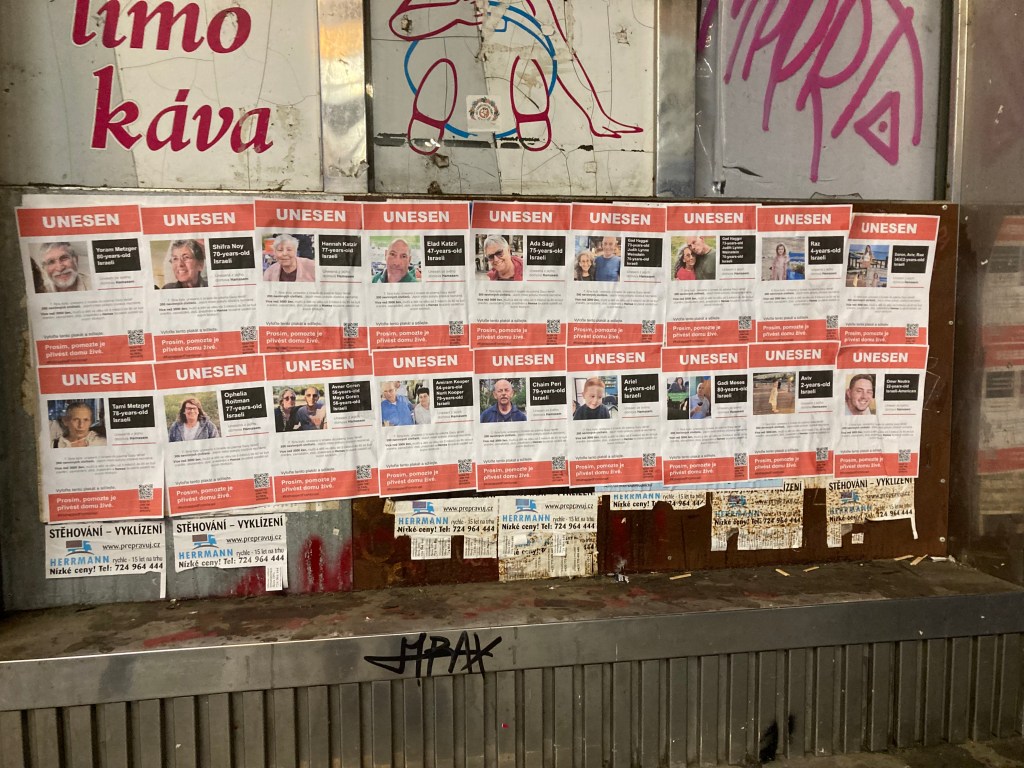
What other people would, in response to the murder and kidnap of their brothers and sisters, have to watch as posters of missing persons are torn down in London (and, in other cities, by the police)? Or learn of tube drivers leading pro-Palestinian chants? Or read of a “massive increase” in antisemitic attacks? Or see the Israeli flag seized from the flagpole of a town hall? Or hear tell of antisemitic flyers distributed in Manchester? Or be subject to obscenely crude provocation? Or discover that 2,000 artists had signed an open letter calling for a ceasefire, less than two weeks after the massacre, which failed to mention Hamas by name or specifically reference the butchery of October 7?
There are examples further afield. The mob in Dagestan seeking Jews at the airport. The shop in Turkey with the sign ‘no Jews’ (note the stress on ethnicity, not nationality). The Star of David being sprayed onto Jewish homes in Paris. I do not ask the question rhetorically: what other people would be subject to this nastiness and bad faith? Such behaviour is not anti-Israeli activism. It is antisemitism.
Backlash against Israel is predictable and expected. But as The Guardian’s Jonathan Freedland noted during a talk for The Jewish Chronicle “…it was the speed of it: they went to the reaction before there’d even been a reaction”. British Jews deserve solidarity because they have every cause to believe that they are, once again, alone. And it is a duty to remind them, no matter how modestly, that they are not.
Here’s Britain’s chief rabbi talking last week to ITV News:
The fear that’s running through the Jewish community now we haven’t heard since 1945… it is palpable right now.
If history offers us any lesson in relation to Jewish people, it is to listen when something like that is said. If one believes that solidarity is worth offering, and is capable of doing so publicly, then to shirk the obligation is cowardice.
Each of us has heard that dumb line used to disarm an opponent, the one where you simply stress the year in an attempt to expose outdated opinions: “I mean, it’s 2023!”. Well yeah, it is 2023 – and here is a recrudescent antisemitism.
I said I’d been reading about Italian fascism. But I’ve also cast the net a bit wider: The Gulag Archipelago (disgracefully, given my age, for the first time); The Pike, Lucy Hughes-Hallett’s masterful biography of Gabrielle D’Annunzio; the equally brilliant France on Trial by Julian Jackson on the prosecution of Marshall Petain; and Czeslaw Milosz’s classic on totalitarianism, The Captive Mind.
These are books about the USSR, Italy, France and Poland in the twentieth century, and are riven with political violence. And running through each and every one of them, is antisemitism; sometimes it is off-stage, sometimes it is at the centre of events, but it is always there. So is the spilling of Jewish blood. The bullying, the intimidation, the sneering, the goading, the libelling… What is the point of all this reading if, when Jews are again attacked and intimidated, one is silent?
If that seems grandiose or melodramatic, then I invite you to ask yourself a question. Had Hamas been capable on October 7 of carrying on their attacks unopposed, had the IDF not eventually intervened, had the attackers been able to spread beyond southern Israel, would the killing have stopped? I contend that the answer is no. The intention was to kill as many Jews as possible, until prevented by force. What else can one call that but genocidal?
It is disturbing but instructive to discover how many people cannot – or refuse to – recognise this simple truth, or who cannot wait to change the subject (even captured Hamas fighters are capable of condemning Hamas). Many (particularly the well educated) are far too eager to settle themselves into their cosy little nest of impartiality, where one needn’t think nor give any cause to offend. Others, more contemptible still, simply do not care, don’t believe or are pleased the attacks on October 7 took place. Such individuals are beyond comment.
I want to address another group of people. Some of them are, I believe, well-meaning and sincere in their wish for justice and peace in Gaza. But they are so blinded by their hatred of Israel, that their minds recoil at the prospect that Israel, in this instance, is not the aggressor, but the victim.
To such a view, there is only one reply. One can condemn the building of settlements. One can hope for a better, freer future for Palestinians. One can mourn the loss of civilian life in Gaza. One can loathe Netanyahu. One can think, if one wishes, that Israel is a bully and that the Palestinians are its number one victim. One can do all of that and more, and still condemn Hamas. One can believe that Palestinians are oppressed, and still call out a slaughter when one sees it has taken place. But there is a reticence, a hesitation. Yes, what happened in Israel was awful, so the line goes, but… And contained in that ‘but’ is the quivering spectre of moral equivocation.
This ‘but’ is growing louder, now that Israel has entered the Gaza Strip and civilians are being killed. The massacre of October 7 is receding into the distance, with the focus understandably on what is happening now. We can see this reflected in the attention afforded to massive pro-Palestinian demonstrations around the world. No moral individual wants to see innocent civilians in Gaza suffer or killed. And speaking personally, I do not make the base conflation of pro-Palestinian activism and criticism of Israel with antisemitism. Instead, I am drawing attention to what British Jews have had to watch, read or be subject to, and am calling it out as dangerous and wrong.
British Jews have articulated with far greater immediate emotional force their own responses to October 7 and the aftermath in Britain. Those of us who are not Jewish, but who cleave to humanist values, ought to offer them our solidarity.
In an earlier post, I wrote of how we Europeans are accustomed to Jewish daily life being subject to police protection (places of worship, schools, social events) and that we should be a great deal less blasé about it. Indeed, I wrote that “there ought to be more shame that this is still considered necessary”. For what other group, apart from Jews, would such robust security be considered acceptable and normal? If Hindu temples or Filipino churches, for instance, required armed guard in the capital cities of Europe, would we be so blithely indifferent? I think not. We would see it for the outrage that it is. And I don’t believe that it is the responsibility of Jews to point this out.
Jews should be entitled, in a Europe that loves to bask in its own sense of enlightened piety, to an ordinary life free of threat and intimidation like everyone else. Instead, Jewish children in Britain are advised to cover up their uniforms, and their schools are vandalised.
Most people, it seems to me, recognise that injustices have been perpetrated against the Palestinians, do not want to see innocent civilians in Gaza killed, and are still appalled at the attack on October 7. But it is sobering to discover that some people – quite large in number – cannot make this fairly easy step. Others are outright hostile. Which is why some British Jews feel unsafe – and which is why they deserve our support.
Giuseppe Modigliani was a socialist and a Jew and thus an irresistible fascist target. He was spat at in the street, assaulted in public and corralled by mobs into spouting fascist slogans. He sported a large beard, which according to one contemporary “made him look like a rabbi in a synagogue”, and to another, like an “old Testament prophet”. In political exile in France when the Nazis swept into the country, Giuseppe refused to shave it off. This was of course courting great danger. When his wife tried to encourage him to get rid of it, he was having none of it: “No, my dear, I have always worn a beard and always shall.”
If he could come up with courage like that, at that time, then we should be capable of taking the very mild step indeed of offering moral support to British Jews.
I am a signatory of the October Declaration, which can be found here.
 Jake Plenderleith