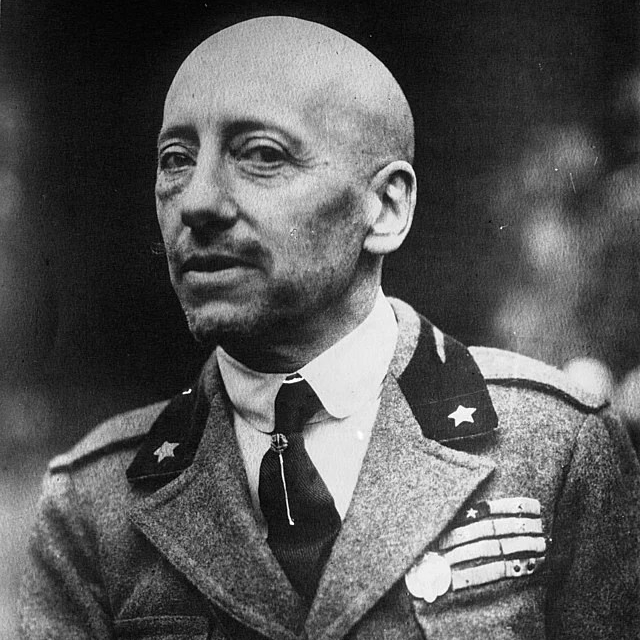
The writer as Übermensch
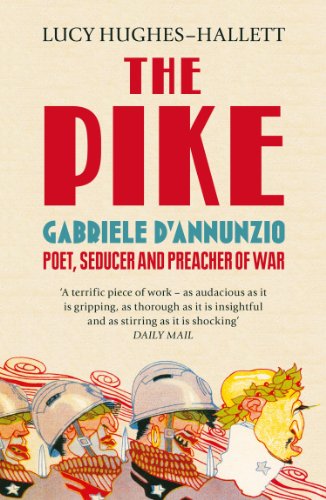
The distinguished British diplomat and Germanophobe1 Lord Vansittart (1st Baron Vansittart, second cousin of T.E. Lawrence) said of Gabriele D’Annunzio, the subject of Lucy Hughes-Hallett’s 2013 prize-winning biography, that he was ‘a first class cad’. Lord Vansittart’s summation is a useful shorthand, but it doesn’t go quite far enough. The evidence of d’Annunzio’s life and character – a man dubbed the ‘John the Baptist of fascism’ – goes beyond mere caddishness. But it does capture d’Annunzio’s spirit: impetuous, romantic, selfish, irresponsible.
One can quite easily see, had he been informed of Vansittart’s remark, d’Annunzio’s mocking smile. Indeed, he and the Baron might have bonded over their mutual dislike of the Teutonic had not Vansittart been an Englishman. For d’Annunzio, Anglo-Saxons and Germanics were ‘barbarians’; the Latins were the noble and superior race. And race, alongside the cleansing and revitalising power of war, is one of the enduring obsessions of d’Annunzio’s rhetoric:
Blessed are the young who hunger and thirst for glory, for they shall be satisfied… Blessed are the merciful, for they shall be called upon to staunch a splendid flow of blood, and dress a wonderful wound…
D’Annunzio’s life and work exemplifies the radicalisation of Europe in the early 20th century. He was among the foremost advocates for ultra-nationalism and military glory, for shedding blood and sacrifice. More than this, he was a pioneering exemplar of how these concepts could be communicated to mass crowds and put into practice. He was a terrific public speaker, and the dictators that emerged from d’Annunzio’s shadow adopted his methods and style. We know today where the notions that d’Annunzio celebrated are eventually headed: to war, to Treblinka, and to the transformation of Europe into a charnel house.
The question is why d’Annunzio – a poet who was never happier than when luxuriating in sensuality, and whom, by temperament, artistic bent and age (he was born in 1863) was a fin de siècle creature – was such a fervent advocate for conflict, for rallying behind the flag. Hughes-Hallett’s book shows us how. Born in the backward Abruzzi to a well-off family, he established his literary credentials early. He studied in Florence before moving to the (new) capital of a united Italy. He frequented salons in Rome and sought (and was granted) entry into high society. He spends money he doesn’t have, begins a series of affairs and attains a scandalous, and to him, delightful, notoriety.
The First World War begins, and d’Annunzio is disappointed that Italy is not a participant. He believes that a country can only truly be born when it has been forged in the crucible of war. The unification of Italy was all too peaceful; Italy was built, but to ‘build Italians’, for the country to become a real nation instead a collection of disparate peoples, d’Annunzio claimed that it must be through a baptism of blood. When Italy enters the conflict, he is thrilled. Heady ideas indeed for a man who doused himself in a pint of Coty’s eau de cologne a day.
Who is this man, who glories in the horrors of war while carrying around “crimson silk cushions”? The book’s subtitle, ‘poet, seducer and preacher of war’ gets to the heart of his pre-occupations. He was a novelist, playwright and poet of some distinction. By the dawn of the century, he was an established and renowned literary figure and a member of the Italian Chamber of Deputies. For many, this would be enough. But for d’Annunzio, his writing was only a prelude to the last act of his life, where his literary fame would be eclipsed by his transformation into an aviator and political leader.
His notoriety rested not only on his work. D’Annunzio was a personality, a celebrity. He neither drank nor ate to excess and kept himself trim by horse riding and boxing, glutting himself instead in the bedroom. He loved to adorn his lodgings (the rent for which was forever in arrears) with expensive objets d’art and luxurious fittings. He was a spendthrift and constantly indebted. He was a snob and an elitist, yet spent much of his life addressing and cajoling the mob. He was a novelist and a poet, who flew in aircraft over cities lobbing bombs.
He was an irredentist. He had a genius for self-publicity. He despised the drudgery of modernity, longing for the cut and thrust of a romantic past, yet wholeheartedly embraced its trappings (planes, motor cars). He possessed tremendous physical courage, but was paralysed when it came time to end a relationship. He inspired hatred and devotion. He had a Niagara of lovers despite being bald and short (contemporaries are endlessly remarking on his ugliness). He was an aesthete who lavished praise on battle.
This reviewer has looked on askance at the emergence of the idea of addiction to sex as on a par with, say, nicotine or alcohol addiction, but d’Annunzio is among the few human beings who could make one think again. He could not, or would not, stop sleeping with women. Sex to d’Annunzio was a ritual and a ceremony, and his priapic adventures were carried out with artistic assiduity:
She is shown into a small sitting room crammed with roses. ‘They were everywhere – in vases, in amphorae, in bowls – and their petals were strewn on the carpets’…The host [d’Annunzio] appears, dressed in a dark blue kimono bordered with black… On a small ebony table a large silver tray has been set, bearing a samovar, two cups, and marrons glacés on silver plates. D’Annunzio pours the tea (Chinese, very fragrant), then seats himself crosslegged on the rug by the lady’s chair, takes both her hands in his and embarks upon his seduction.
D’Annunzio’s endless string of lovers was longer than Ariadne’s thread. This insatiable carnal desire was indisputably connected with his very evident death wish. During the First World War, he repeatedly took part in flying raids (scattering either pamphlets or bombs) that put his life in grave danger. He did so not just because he yearned for an Italian victory, but because he found the proximity of death stimulating. There was an erotic thrill to his risking his life.
The futility and destruction of the First World War had a devastating effect on Italian democracy, radicalising a generation of soldiers who found an outlet on their return home in the arms of both the far-left and far-right. It is not hard to see why: “By the time snowfall put a stop to the fighting seventeen days later, 67,000 Italian soldiers had died to gain a strip of land about a hundred metres across.” The disaffected men who survived were putty in d’Annunzio’s hands, whom he harangued with perorations that promised retribution.
His crowning moment, the heights of which he never again attained, was his one-man rule of the small city of Fiume (today Rijeka, Croatia). The lively port city on the Adriatic, with a mixed population of Italians, Croats and Hungarians, was up for grabs following the dissolution of the Austro-Hungarian Empire. The newly formed Yugoslavia wished to annex it to its territory. D’Annunzio thought otherwise and in 1919, against the Italian government’s wishes, led a band of his followers into the city, which he ruled in his Dionysian fashion for 15 months. The Treaty of Rapallo put an end to d’Annunzio’s great adventure, and he and his followers skulked home, by which time, there was another demagogue ready to follow d’Annunzio’s example on a national scale.
It isn’t difficult to see in d’Annunzio a precursor of Mussolini. The two collaborated while Mussolini was still a socialist, and indeed many fascists looked to d’Annunzio as a potential leader when Mussolini prevaricated in toppling Italian democracy. D’Annunzio had, after all, already performed the role of Il Duce with aplomb. But the two men’s distrust was mutual. Mussolini recognised a rival when he saw one, and d’Annunzio was careful to never fully endorse fascism. Nevertheless, “though d’Annunzio was not a fascist, fascism was d’Annunzian.”
Why d’Annunzio never explicitly backed Mussolini might seem odd. Their political instincts crossed over: both found democracy repellent, both sought the revitalisation of Italy and the creation of a Third Rome, the foundations for which d’Annunzio had laid. The bathetic truth is that d’Annunzio had neither the stomach nor the patience for real power. The spadework of committee meetings was to him anathema. He could not commit his attention to the drudge work of administration. D’Annunzio exulted in spectacle, in marches and festivals and banners and parades. His politics was an artistic outlet, a creative endeavour which was, crucially, utterly centred on himself. D’Annunzio’s ego forbade the idea that he would play even a minor part in Mussolini’s show. Snobbery, too, probably had something to do with it.
Hughes-Hallett approaches the dizzying life of her subject with a clear head. D’Annunzio, under her microscope, is offered no indulgences, his faults and successes neither glossed over nor underplayed. Her narrative is episodic and thematic more than chronological, though the book ends with the entwining of Mussolini’s and d’Annunzio’s lives, the former’s expanding in power and influence, the latter’s diminishing.
It is difficult to find D’Annunzio entirely reprehensible. His energy is enviable, and his talent with the pen was acknowledged by luminaries as exalted as Proust and Joyce. But his repeated invoking of blood and soil is repellent. Wholly modern in his attitude to cars and women, nothing has aged d’Annunzio more than his jingoism. “He was moved by the sweetness of small children. He was very kind to his dogs. But the woman who brought him in his meals, he once wrote, was no more to him than a piece of furniture, a cupboard on feet.” That sounds about right. Those who sentimentalise animals and the young very often are heartless bastards.
- Vansittart, who had no delusions about Hitler and recognised the threat he represented immediately, was a committed opponent of appeasement. ↩︎
 Jake Plenderleith